Apple - Tree: Inherited Wounds, Redeemed Identity
“Apple—Tree!” If you were to spend any amount of time around my family, you would hear us say this phrase often. Why? Because we say it whenever my son does something my husband would do. Typically it’s something that’s silly, quirky, or maybe the tiniest bit on the annoying side. We also say it when my toddler grandson acts the way my son did when he was that age. It really is shocking how similar they all are! Hence our phrase, “Apple—Tree,” because it’s true: the apple doesn’t fall far from the tree. Maybe it’s only funny to us, but regardless, there’s no denying they’re related.
It got me thinking, though. There are a lot of physical and physiological characteristics passed down from biological parents. Things like eye color, hair color, freckles, blood type, and even whether looking at the sun makes you sneeze. Weird, I know, but true!
But what about the things that aren’t always visible? What about the things we believe about ourselves or the wounds we carry? I know I just got serious pretty quickly, but I had a moment the other night and I thought I’d share it with you. Maybe you’ll be able to relate.
My husband Drake and I were making dinner, and all was well. But he unknowingly said something that took me back to a painful childhood moment—one when my dad made a comment that was incredibly hurtful.
Drake’s comment wasn’t remotely the same as what my dad said, but the connection my mind drew stopped me in my tracks and brought immediate tears. The kind of tears you try to blink away, but they keep coming. It felt like my emotions reacted before my brain had time to process what had happened.
I was triggered. I’ll admit, I don’t love that word, but it applies.
When I caught my breath and explained the reason behind my reaction, Drake felt terrible. He assured me that I was not what my dad had said about me. Most of me knew that to be true. But I also think there can be a gap between what we know to be true and what we feel—or what we truly believe. Those gaps are real, and they can make walking in our faith rough. They can leave us feeling alone or even like we’re failing to believe what God says about us.
Here’s what I’m learning about those gaps. Instead of seeing them as lonely places or signs that I’m failing, I’m trying to see them as invitations.
They are personal invitations from God to meet Him in those moments — to show me why I might still be hurting, and patiently teach my heart what my mind may already know. And, since I consider you a friend, I’m going to share how I’m learning to approach these moments. I ask three questions:
1. God, where is this feeling coming from?
2. What am I believing in this moment?
3. What do You say is true?
I wish I could go into more detail here, but in the interest of keeping your coffee, tea, or whatever you’re sipping from getting cold, or warm, I’ll save that for another time. What I will say is, I trust that when we prayerfully bring these questions to God, He will meet us there. The answer may not come immediately or look the way we hoped, but He will faithfully lead us toward His truth.
I hope you can pause for just a second and let that settle to a safe place in your heart. Because if you’re like me, it’s something you might need when you feel overwhelmed in a gap. Those gaps aren’t fun and can be hard and confusing places to find ourselves.
We know what God says is true, so we think we should be able to make ourselves feel it immediately. But I know for me, healing doesn’t always happen that way. Some layers run deep. We might not even know they’re there - until you’re find yourself crying in the kitchen while making dinner with your husband.
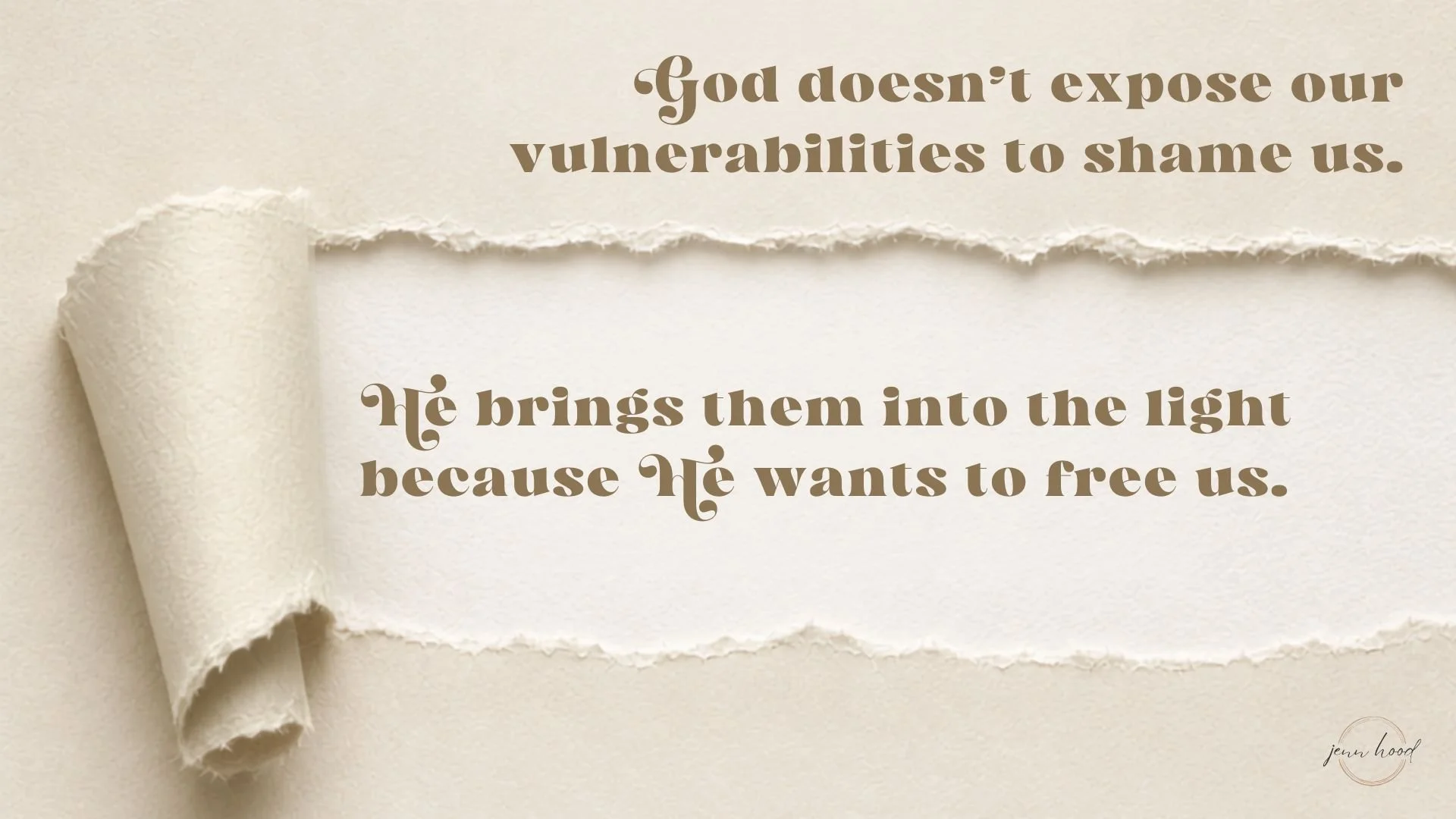
I also want to add that not every strong emotion means we are believing a lie, and we don’t have to dissect every painful memory. But it is important to pay attention. Sometimes our reactions reveal a place within us that still needs tenderness and the healing truth of God. And revealing isn’t the same as condemning. God doesn’t expose our vulnerabilities to shame us. He brings them into the light because He wants to free us. We don’t have to hide, dismiss, or simply try to live around them. We get to walk in the beauty of what God says is true and who He says we are. (1 Peter 2:9 NIV)
It makes me think of the Apostle John. Throughout his Gospel, the writer repeatedly refers to himself as “the disciple whom Jesus loved.” (John 13:23 NIV)
He didn’t describe himself by his accomplishments, by how close he was to Jesus or anyone else, or even by his failures. The identity he held onto was this: I am loved by Jesus.
Please pause with me here and really let that soak in. You and I are loved by Jesus too!
That is the truth I want woven into every part of me—the parts that already believe it and the tender places that aren’t there yet. Or, in other words, the gaps. I believe God is working there, patiently guiding my heart to believe His truth - even in the hard-to-reach places shaped by other voices.
So when an old wound unexpectedly surfaces, I’m slowly learning not to be angry with myself or think, ‘I shouldn’t still be bothered by this.’ Instead of denying it or pushing past it, I pause—sometimes for a long, deep breath—and bring all of it honestly to God: the hard parts, the ugly parts, and the confusion.
I ask God to help me understand the root of my pain or struggle and to begin removing what doesn’t belong there. The more I do this, the more familiar His truth becomes, gradually replacing the voices and lies that shaped me before I understood how deeply I am loved.
I believe the same can become true for you.
God isn’t trying to be elusive with His love for you. I believe this—but more importantly, He’s shown it. He made His love known through Jesus. (1 John 4:9 NIV)
I wish none of us had painful things passed down to us. But they don’t get to define us. Because of Jesus, the deepest and most beautiful truth about us isn’t found in a wound we inherited, a label someone placed on us, or the fear, insecurity, or anxiety we picked up along the way.
The truth is this:
We are the ones Jesus loves.
Our identity is in Him.
“Apple—Tree.”